Posts

The Lowest Common Denominator pet peeves list

The lowest common denominator (LCD) "the most basic, least sophisticated level of taste, sensibility, or opinion among a group of people," according to thefreedictionary.com In youth soccer, I often hear coaches and parents relying on the LCD to relay information to their players. In the quest to make the game easier for their players, they often end up building up patterns that are hard to break later, even among the strongest players. I have compiled a short list below and will add to it as I hear more of these comments. Throw-ins "Throw it down the line" Data from youth soccer games shows that the most likely outcome of a throw in is a turnover. Players struggle to throw the ball to a teammate and when they do get it to a teammate, the pass is of such poor quality that the other team ends up with the ball either as a throw-in or as a turnover. In an attempt to simplify the game, coaches just encourage (ok, yell at) their players to throw it down the line. W...

Why I don't like World Cup, but I do love transition games.

Image
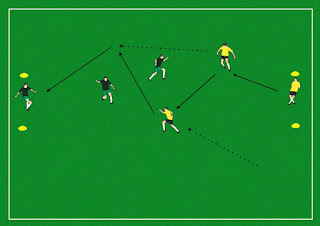
One of the all-time favorite games that players want to play is called World Cup. There are variations on how to play it, but basically everybody on the team pairs up (so if you had 14 players, you would have 7 teams). Each team chooses a country to represent. One player plays in goal and the teams try to score. The GK plays a ball out and then there is a free-for all as the team play 2 vs everyone else. When a player shoots, they are supposed to shout out the name of their country. If they score without calling out the name, then the goal doesn't count. When a team does score, they get to sit out until there is only one team remaining that hasn't scored. Then you start round 2 with 1 less team. If played properly, then this game lasts 6 rounds. With each round seeing more players out, it very quickly becomes a game that has more watchers than participants. In addition, it takes a long time to play. If you counted the average number of touches each participant takes during th...

U10 game modifications

The U10 game is the first one that incorporates a referee, player passes and a game card. It is also the first age group that keep tracks of results. When I first started working with the Impact, I observed lots of U10 games and as a result, I came up with a couple of modifications to emphasize skill and possession. There is NO PUNTING in U10.  When the GK gets the ball under control, the last thing we want to have him/her do is to kick the ball away. When the GK does punt the ball, the other team gets possession about 80% of the time. In addition, players have a hard time judging the speed and direction of the ball, so when the ball is in the air, they either cower from the ball, try to play it with their head or let it bounce over their head. None of these results makes it easy for the attacking team to retain possession. Instead of punting, the GK can throw the ball, roll the ball to a teammate or put it on the ground and pass it to a teammate. the GK's most important job i...

U5/6 game modifications

The U6 game has evolved quite a bit from 20 years ago when we played them 11 v 11 with goalkeepers and positions because it was "like the real game." Today, we play a game that the players can understand, develop skills and enjoy playing the game because it is more appropriately scaled to their understanding of the world. In addition to the national federation rules regarding U6 games, we have added some modifications to improve the player experience and increase our likelihood of achieving our player development goals. Use a size 3 ball.  Sometimes, kids come to practices and games with larger ball sizes (4 or 5). Check that out and see that you have a size 3. We play 4 v 4 Having fewer players on the field decreases the complexity of the game. There are no GK's at this age group either, so as a coach, all you have to do is manage how long each player plays before taking a break. Plan the game matchups with the other coach before the game.  We want to challenge ...

Eliminating Games of Elimination

Taking they National Youth License course way back in 1999 was a transformative experience for me. I learned so many things, I have trouble keeping track of them all. In addition, it allowed me to more fully develop my personal coaching philosophy centered around the developmental stages of the children and what appropriate activities are for each of the different stages. We know that the worst thing you can do to a player who has come to practice is not let them play. However, we employ lots of activities where that exact thing happens. How can we eliminate that element of our practices? One of the most popular dribbling games around is sharks and minnows. You know the rules. A couple of sharks chase the players as they dribble around and try to keep their ball away from the sharks. When a player has his or her ball kicked out, they are eliminated and sit out until the game is over. The last couple of players with their balls get to be the sharks in the next round. The problem wit...

3 v 3 when to dribble or when to pass for U10 and above

Image
One of the reasons why I have stayed in this game so long is that I am constantly learning new things and I get excited about trying them out with the teams and coaches in my club. The exercise I am going to describe today was one I learned from a State Instructors Seminar run by my state DOC, Jacob Daniel, back in 2010. From the title, it sounds like a typical 3 v 3 game, but over the years, I have expanded it out to 7 v 7 and even larger. The great thing about it is that it can work with a U10 rec team as well as a high level select team. The setup is simple, 3 players on a 15 x 25 yard grid with a 5 foot goal at each end. Depending on the size of your team, you can have up to 3 grids going at once in the first level. In a typical 3 v 3 setup, all of the players are moving and switching positions. In this game, there is one designated player who is the nominal GK. In a real game setup, this would be your #6 (defensive mid or holding mid), or possibly your #4 or 5 (center backs) pla...

U8 game modifications

Here are some notes for game play in the U8. In addition to the small-sided game rules, we have made some modifications to our U8 game play to make games more competitive for as many players and teams as possible. Starting Fall 2016, we play 4 v 4 with no GK Impact Recreational program used to play 4 v 4 prior to 2007. While the US Youth Soccer Association recommended a 4 v 4 format for the U8, we incorporated a GK and turned it into 5 v 5 games with a GK and 4 field players. With all of the changes, USYSA reiterated that U8 should play a 4 v 4 format. As a result, we will now be in line with the recommended format. It may be that you play a pre-academy team and choose to play a man up with the 5th player in goal, but that is up to your discretion. UPDATE FOR SPRING 17 Just so we are clear on this point. You are playing 4 v 4 without GK's. That is where you start. If, in your discussions with the other team's coach, you mutually decide to vary from 4 v 4 to make the gam...